

Fertility, but Make it Existential
A world of mirrors and ghosts, or: the Met bedazzles the sparkliest opera that Strauss ever composed.
Performers:
Vocal Soloists; Elza van den Heever (as the Empress), Lise Lindstrom (as the Dyer’s Wife), Nina Stemme (as the Nurse), Issachah Savage (as the Emperor), Michael Volle (as Barak, the Dyer), Ryan Speedo Green (as Spirit Messenger)
Other Contributors; Yannick Nézet-Séguin (conductor), Herbert Wernicke (production/designer), J. Knighten Smit (stage director), Scott Weber (dancing a mime of the Falcon)
Program: Strauss’ Die Frau ohne Schatten (libretto by Hugo von Hofmannsthal), performed by the Metropolitan Opera and their ensembles.
Position: Family Circle, utmost left seat a couple of rows up.
Purpose/Intent/Questions: This is one of my favorite operas, conceptually, and it is certainly not in last place musically. I’d never seen this production and figured I might as well give it a shot seeing as I was in town.
How’d it go?
Buckle up, friends. These are not my typical show notes. I’ve never been to an opera before where there was so much distracting from the opera, both within and beyond the production.
The first matter is that while I understand the idea between setting the world of the Empress (i.e. “the woman without a shadow”) in… a fully mirrored landscape, with mirrored costumes, and light bouncing off of anything or anyone who might otherwise cast a shadow… this is one of the unfortunately many examples of design that is considering the viewer on the other side of a camera and screen than the viewer who paid to be in the opera house. This is a recurring theme at the Met, but this production was especially blinding. Many in the audience were shielding their caption screens, if not their eyes, through much of the performance, making it difficult to following anything other than the music. And because the music was simply fine, not especially riveting, not justifying the cost of a trip to the theatre rather than simply listening at home, it felt all the more damning. Is this a production, or is it a new version of the “visualizer” in the complimentary music player that comes with one’s computer of choice?
I like sparkles. I love shiny stuff. I want for this sort of thing to work. But it was forced in a way that compromised the focus, the tension, the drama, shoving the story into the background—a mere shadow beyond the lightplay.
Because of this Scott Weber, dancing the falcon, was able to stand out as exceptional. It’s uncomfortable when choreography and dance execution are the highlight of an opera, but credit where it’s due. An athletic, graceful bird dressed in red, Weber was an enchanting dancer in the middle of a production that seemed set on shaking off my attention.
Fortunately, my attention found other outlets.
On rare occasion, you can seemingly hear the SlippeDisc article1 being constructed around you:
Patrons seated in the Family Circle at New York City’s Metropolitan Opera were treated to more drama than they paid for during the second act of Die Frau ohne Schatten.
As has become more common in our times, a member of the audience thought it might be alright to photograph the performance—with flash on, during an opera where light is a pretty obviously significant symbol and used to construct the story. As is typical in such situations, the flasher was met with many death stares in the dark and variously verbalized tutting.
What was beyond the norm was that another patron simply grabbed the offending phone and chucked it down the stairs! This was responded to with indignation from the flasher, who got up to argue with the chucker, demanding retrieval. Calls for an usher were eventually heeded, with security joining in to help the flasher leave.
During the second intermission, the chucker was complimented for his action, with many of those seated in the area suggesting that the Met should apologize to him and tighten their policies; others simply said they wish they had the nerve to do what he did.
Honestly, I’m not sure what she managed to photograph. Or why she thought that the flash might help.
Somehow, this was not the greatest distraction of the performance. Beyond the mirrors and the unsolicited photography, there was something on stage that took me far, far out of the story. Beyond the realm of the shadowless Empress, beyond the home of the Dyer and his wife, all the way down to the Southern Cone, back to my graduate studies…
Who… who are those lovely folks in the back, the ones with the torches?
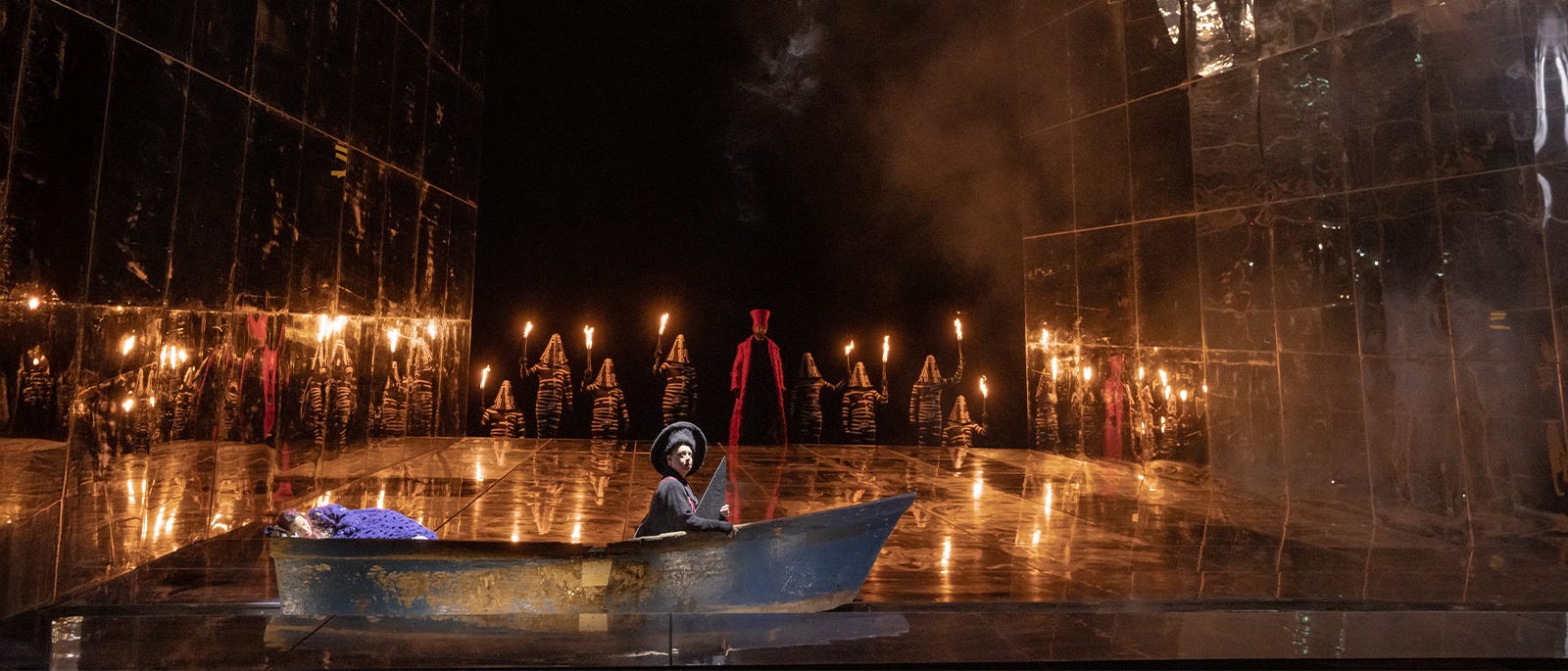
Oh, they’re “the spirits of the unborn!” That makes sense. Let’s get a better look. Some traditions believe that even our souls have a likeness to our parents, so maybe we can see…
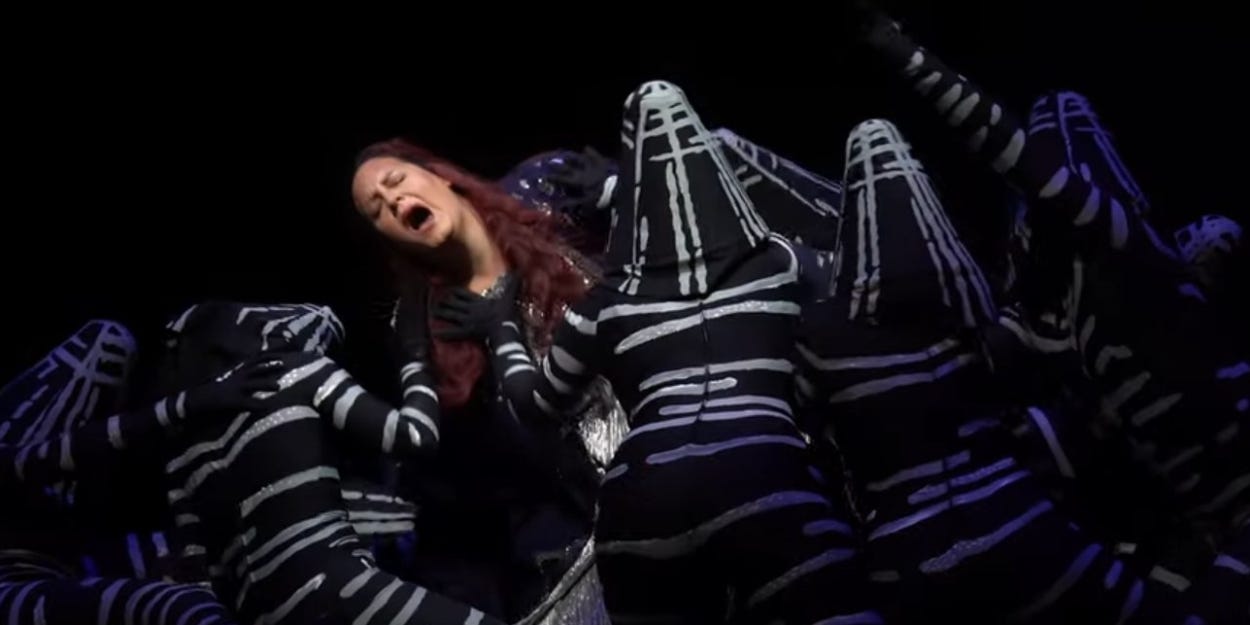
Hm. I’m starting to think that those aren’t actually the spirits of the unborn “in zebra stripes.” I’m actually pretty sure that’s… Ulen.
If you’ve been to my place in the past decade, you probably recognize him. If you’ve been to Chile or Argentina, he might be a bit familiar. Sometimes he’s depicted in red, rather than black and white. That’s his true form. It’s just that the people he belongs to were genocided before color photography was widely available to anthropologists, so his natural coloration has been distorted by his image on postcards.
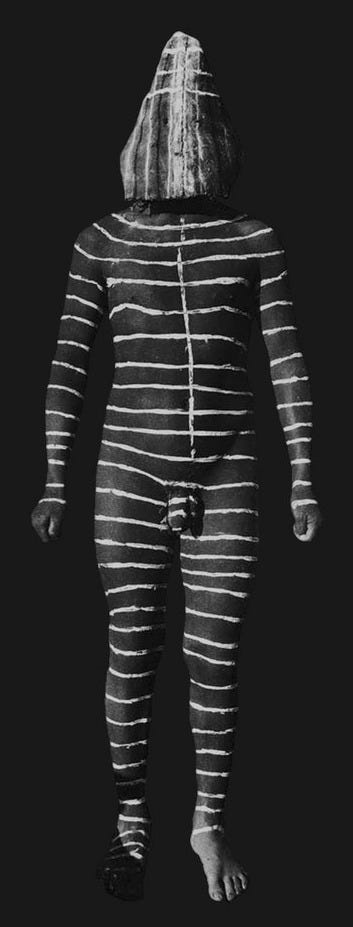
Ulen, one of the Selk’nam spirits, a shoort to be precise, was invoked in their spiritual ceremony, the Hain—which had developed into a culturally oriented (as opposed to religious) large-scale social theatre by the time Europeans arrived to Tierra del Fuego—and is a bit like a jester. Ulen’s role was to entertain people, often by scaring or bringing some amount of pleasure to women in the community.
Maybe he is an unborn spirit!
Maybe there is some great metaphysical connection between indigenous theatre traditions and productions at the Met. Maybe all of the peoples destroyed by Europeans’ arrival in the New World have found their afterlives in opera.
But he is what and who he is.
I even checked with the one person in the world most eager to disagree with me: my brother, my only brother, whom I love, Michael. He agrees that these costumes are absolutely little Ulens running about on stage, not a spontaneous aesthetic invention of Wernicke.
But No’a, you might protest, this is so obscure. The Selk’nam might as well be a non-people, at this point.
I actually do not believe that I’m the only Met Opera attendee who has been to Chile for a long enough period to register the absolutely striking aesthetics of the Selk’nam. I might be the only one who keeps up with Keyuk Yantén’s language revival project, but even this I doubt.
Whether this is blatant and irrelevant cultural appropriation or something condoned by one of the now-gone elders of the tribe with a real meaning, I cannot know. But it reinforces to me that art and knowledge need to be sensible dance partners. It’s a shame to know too much to appreciate an aspect of a work of art, to not know enough to find a way to appreciate its place within the whole.
In the words of the Sages, ay mio.
While this sundry bit of mundane scandal was too high in the rafters to be worth a post from Mr. Lebrecht… it’s not out of step with the sort of material published in classical music’s dedicated industry tabloid. There shall be other phones and other flashers, unfortunately.